
What Is Roundnet? A Complete Beginner’s Guide
Roundnet, often known as Spikeball, is a fast, social sport played around a small circular net. Learn the basics, key rules, court markings and how to get involved with Hinckley Roundnet.
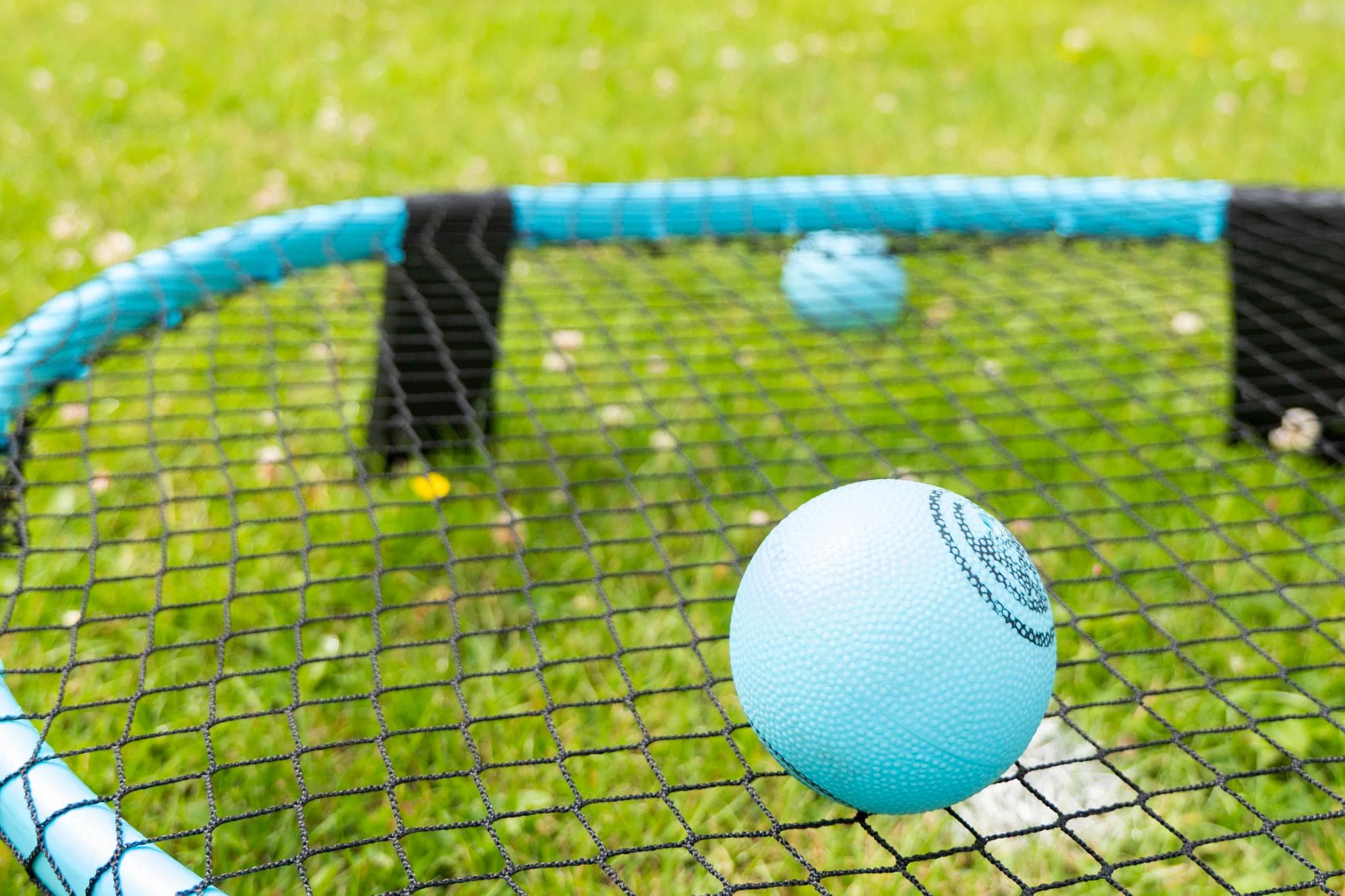
If you’ve ever seen four people gathered around a small circular net in a park, chasing a ball, diving across the grass and trying to keep a rally alive, there’s a good chance you’ve already seen roundnet in action.
You might know it as Spikeball, and that’s completely normal. Spikeball is one of the best-known brands in the sport, so a lot of people use the names Spikeball and roundnet interchangeably. Technically, roundnet is the name of the sport, while Spikeball is a brand of roundnet equipment. In everyday conversation though, most people understand both names to mean the same game.
At Hinckley Roundnet, we’re helping more people in Hinckley and the surrounding area discover just how fun, social and addictive the sport can be. Whether you’ve never played before, you’re looking for something active to do with friends, or you’d like to try a new sport without any pressure, roundnet is a brilliant one to start with.
This guide explains what roundnet is, how it’s played, what equipment you need, what the court markings mean, and how to get involved locally.
Roundnet explained simply
Roundnet is a team sport usually played two versus two.
Instead of hitting a ball over a net, like in volleyball, players hit the ball down onto a small circular net that sits close to the ground. The ball bounces up from the net, and the other team then has to use three touches to return it.
The easiest way to think about it is:
Bump. Set. Spike.
One player might control the ball, the second player might set it up, and the first player returns to send it back onto the net. Once the ball bounces off the net, possession switches to the other team.
The rally continues until one team can’t return the ball legally.
That’s the simple version. The fun comes from how fast, creative and unpredictable the rallies become once everyone starts moving around the net.
Why is it called roundnet?
The name comes from the round net used in the middle of the game.
Unlike sports with a traditional straight net, roundnet is played all the way around the equipment. After the serve, there aren’t fixed sides. Players can move around the full 360 degrees of the net, which makes the game feel open, fast and constantly changing.
One rally might be controlled and tidy. The next might involve a sprint, a last-second save and a shot from an angle nobody expected.
That’s part of what makes roundnet so exciting. It’s simple enough to understand quickly, but every rally feels different.
Is roundnet the same as Spikeball?
In everyday conversation, yes, pretty much.
A lot of people say Spikeball when they’re talking about roundnet, because Spikeball is the brand that helped make the sport popular. You’ll often hear both names used to describe the same game.
The main difference is that Spikeball is a brand, while roundnet is the sport itself.
It’s a bit like people saying “Hoover” when they talk about vacuuming. Everyone understands what they mean, but one is the brand name and one is the activity.
So, if someone says they play Spikeball, they’re usually talking about roundnet.
What equipment do you need to play roundnet?
One of the best things about roundnet is how simple it is to get started.
You need:
- A roundnet set
- A roundnet ball
- Four players
- A bit of open space
A regulation roundnet set is circular, with an inner diameter of 91.4cm at the top and a height of 20.3cm. The ball is small, light and inflatable, with the official IRF ball size sitting around 29cm to 31cm in circumference when inflated for play.
For casual games, you don’t need to worry too much about exact equipment measurements. If you’re coming to a beginner session, the main thing to know is that the set is portable, quick to assemble and easy to carry.
You can play on grass, sand, an indoor sports hall, or any flat surface with enough room to move safely - just watch yourself if you choose to dive on a harder surface.
How do you play roundnet?
The basic rules are easy to pick up.
Two teams of two stand around the net. A player serves by hitting the ball onto the net towards the receiving player on the other team. The receiving team then has to use three touches between them to return the ball back onto the net.
Once the ball comes off the net, it belongs to the other team.
A rally ends when one team can’t return the ball legally, the ball hits the ground or the rim, or a player commits a fault.
You win a point when the other team:
- Lets the ball hit the floor
- Hits the rim instead of the net
- Takes more than three touches
- Fails to return the ball onto the net
- Hits the ball onto the net and it bounces more than once
- Catches, carries or throws the ball instead of cleanly striking it
- Gets in the way of an opponent’s play, which is known as a hinder
- Commits a serving fault twice in a row
Roundnet uses rally scoring, which means either team can win a point on every rally, no matter who served.
What are the court markings in roundnet?
This is where roundnet can look a bit confusing at first, because casual games and official matches aren’t always set up the same way.
If you’re playing casually in a park, you might just put the net down and play. That’s absolutely fine for learning.
In official IRF rules, the court has a few important markings.
The roundnet set
The roundnet set sits in the centre of the court.
Everything else is measured from the centre point of that set. That makes the court easy to understand because all the key markings are circles around the net.
The service line
The service line is a circle drawn 2.6m from the centre of the court.
Because the net itself has a diameter of 91.4cm, this puts the service line roughly 2.13m from the edge of the set.
In simple terms, the server has to serve from outside this line. It stops players from standing too close to the net and smashing serves from an unfair distance.
The No Hit Zone
The No Hit Zone, often shortened to NHZ, is a circle drawn 100cm from the centre of the court.
This is one of the rules that newer players often haven’t heard of.
The idea is simple: you can’t step into the No Hit Zone while making an attacking hit onto the net, and you can’t let your momentum carry you into it straight after that hit.
You can still enter the No Hit Zone during a rally to receive, set, defend or move through the area. The restriction applies when you’re making the final attacking hit onto the net.
The purpose of the NHZ is to stop players from standing right over the net and killing every point from close range. It creates more space, more rallies and a fairer game.
For casual beginner sessions, the No Hit Zone can be introduced gradually. You don’t need to know it perfectly before your first game, but it’s useful to understand once you start playing more regularly.
The outer boundary
Official IRF rules also include an outer boundary line drawn as a circle with a radius of 8.5m from the centre of the court.
This doesn’t mean the game suddenly becomes like tennis, where every shot outside the line is automatically out. Roundnet is still built around free movement and 360-degree play.
The outer boundary helps define the playing space, especially in organised games, tournaments and indoor venues. It gives players, organisers and observers a clear area to work with, while still keeping the sport open and fluid.
How does serving work?
A point starts with a serve.
The server stands behind the service line and hits the ball onto the net towards the designated receiver. The receiver is the player standing opposite the server at the start of the point.
The serve has to give the receiver a fair chance to play the ball. If the serve is illegal, it’s called a fault. If the server commits two faults in a row, the other team wins the point.
Common serving faults include:
- Missing the net
- Hitting the rim
- Serving too high
- Serving too close
- Serving in a way that doesn’t give the receiver a fair play on the ball
- Moving illegally before serving
You don’t need to memorise all the serving rules before you try roundnet for the first time. At beginner level, the main aim is to serve fairly, get the rally started and keep the game flowing.
What happens during a rally?
After the serve, the game opens up.
There are no fixed sides. Players can move around the full 360 degrees of the net. Your team has up to three touches to get the ball back onto the net, but you don’t have to use all three unless you're receiving a serve.
For example, your team might play:
Touch one: control the ball
Touch two: set your teammate
Touch three: hit it back onto the net
Or, if the ball comes off the net nicely, you might return it in one or two touches.
The only key rule is that one player can’t hit the ball twice in a row, unless a specific rule allows it (such as a soft touch). For beginners, the simple version is: take turns with your teammate and try to return the ball within three touches.
How do you score in roundnet?
Roundnet uses rally scoring.
That means a point is awarded after every rally, regardless of who served. If you win the rally, you win the point.
Games are commonly played to 11, 15 or 21 depending on the session, format or event. In organised play, games are typically played to 15 or 21.
Usually, you have to win by two clear points. So if a game to 21 reaches 20-20, it doesn’t end at 21-20. Play continues until one team leads by two.
However, there can also be a hard cap. Under IRF rules, tournament directors can set a hard cap before the game starts. For example, if the hard cap is 25 and the score reaches 24-24, the next point wins. At that point, the usual win-by-two rule no longer continues.
For casual games, you can keep scoring simple. Pick a target, play to that number, and adjust based on time, energy and how many people are waiting to play.
What is a hinder?
A hinder is when one player gets in the way of an opponent’s chance to play the ball.
Because roundnet is played in 360 degrees, players are constantly moving around each other. That means space and awareness matter.
You’re allowed to move freely, but you can’t block, trip, screen or physically impede an opponent who’s trying to reach the ball. If a hinder affects the point, the rally may be replayed or awarded depending on the situation.
At beginner level, the best approach is simple: once you’ve played your shot, clear space and let the other team move.
Roundnet is competitive, but it relies heavily on fairness and good communication.
Is roundnet hard to learn?
Roundnet is easy to learn, but difficult to master.
That’s one of the best things about it.
Most beginners understand the basic idea within a few minutes: keep the ball up, use up to three touches, and hit it back onto the net.
At first, rallies might be short, messy and a bit chaotic. That’s totally normal. Nobody starts by playing perfect three-touch rallies.
Once you get the hang of it, the game becomes much more tactical. You’ll start learning how to set your teammate, place your shots, defend space, read angles and decide when to play safe or go for a winner.
There’s plenty of room for athleticism, but you don’t need to be super fit to start. Roundnet can be adapted to suit the group, which makes it great for mixed abilities.
You can take it seriously, keep it casual, or land somewhere in between.
Why is roundnet becoming so popular?
Roundnet has grown because it’s quick to learn, easy to set up and genuinely fun to play.
It combines the teamwork of volleyball, the reactions of tennis, the movement of football and the social feel of a game you can play in the park with friends.
It’s also exciting to watch. Good rallies are fast, dramatic and full of last-second saves. Even if you’ve never played before, you can usually understand what’s happening straight away.
Across the world, the sport is becoming more organised, with national governing bodies, shared rules, rankings and international competitions helping roundnet grow from a casual garden game into a recognised sport.
In Britain, British Roundnet helps develop the sport across England, Wales and Scotland, supporting clubs, events and opportunities for more people to get involved.
Who can play roundnet?
Pretty much anyone.
Roundnet is popular with students, families, sports clubs, community groups, fitness enthusiasts and people who simply want something fun and active to do outdoors.
You don’t need loads of equipment. You don’t need a full squad. You don’t need to join a league before having a go.
That’s one of the reasons we love it at Hinckley Roundnet. It gives people a low-pressure way to get active, meet others and try something different.
Some people come along for the social side. Some enjoy the fitness. Some get competitive very quickly. All of those are welcome.
Is roundnet good exercise?
Yes. Roundnet can be a brilliant workout, but it doesn’t feel like a boring one.
A typical game involves short sprints, quick changes of direction, hand-eye coordination, balance, reactions and teamwork. You’ll move more than you expect, especially once the rallies start getting longer.
Because the game is so engaging, you’re usually focused on the next touch, the next save or the next shot rather than thinking about how much running you’re doing.
That’s what makes roundnet a great option for people who want to be active but don’t necessarily enjoy the gym or more traditional sports environments.
Why play with Hinckley Roundnet?
Hinckley Roundnet exists to help more people discover the sport locally.
Our aim is simple: make roundnet accessible, welcoming and fun for people in and around Hinckley.
You don’t need experience. You don’t need your own set. You don’t even need to know all the rules before you turn up.
We’ll show you how the game works, get you involved at a level that feels comfortable, and help you build confidence as you play.
Whether you’re looking for a new hobby, a fun way to exercise, a social activity, or a competitive sport to get stuck into, roundnet is well worth trying.
Come and give roundnet a go
Roundnet is fast, friendly and surprisingly addictive.
It’s simple enough to learn in one session, but exciting enough to keep coming back to. You can play casually with friends, join local sessions, or work towards more competitive games as your skills improve.
So, the next time you see a small circular net in the park, you’ll know exactly what it is.
It’s roundnet.
And if you’re in Hinckley or nearby, we’d love to help you try it.
Follow Hinckley Roundnet for local sessions, taster events and beginner-friendly opportunities to get involved.
Frequently asked questions about roundnet
Is roundnet the same as Spikeball?
In casual conversation, yes, the names are often used interchangeably. Spikeball is a popular brand of roundnet equipment, while roundnet is the name of the sport. If someone says they play Spikeball, they’re usually talking about roundnet.
How many players do you need for roundnet?
The standard format is two versus two, so you need four players. There are also other formats, including three versus three, but 2v2 is the main version used in most casual and competitive games.
How many touches do you get in roundnet?
Each team gets up to three touches to return the ball onto the net. You don’t have to use all three touches, but you can’t take more than three.
Can one player hit the ball twice in a row?
As a beginner rule, no. You should alternate touches with your teammate. There are more detailed rules around certain contacts, but for your first few games, the simple version is that one player shouldn’t take two touches in a row.
What happens if the ball hits the rim?
If the ball hits the rim, the rally usually ends and the other team wins the point. The aim is to hit the ball cleanly onto the net surface, not the plastic frame.
What happens if the ball hits the ground?
If the ball hits the ground, the rally is over. The point goes to the team that didn’t let it drop.
Do you have to win by two clear points?
Usually, yes. In most organised games, you need to win by two clear points. However, a hard cap can be set before the game starts. If there’s a hard cap of 25 and the score reaches 24-24, the next point wins.
What is the No Hit Zone in roundnet?
The No Hit Zone, or NHZ, is a circle 100cm from the centre of the court. You can’t step into it while making an attacking hit onto the net, and your momentum can’t carry you into it after that hit. It helps stop players from attacking too close to the net.
Is there a boundary in roundnet?
In official IRF rules, yes. The outer boundary is a circle with a radius of 8.5m from the centre of the court. In casual park games, people often play without marking it out, especially when they’re just learning.
Is roundnet difficult for beginners?
No. Roundnet is beginner-friendly because the basic idea is simple: keep the ball up, use up to three touches, and hit it back onto the net. The more advanced rules and tactics can be learned as you go.
Do I need to be fit to play roundnet?
You don’t need to be super fit to start. Roundnet can be played casually or competitively, so the intensity depends on the group. As you play more, it naturally helps with movement, reactions, coordination and fitness.
Where can I play roundnet in Leicestershire?
You can play with Hinckley Roundnet. We’re building a friendly local roundnet community for people in and around Hinckley, Leicestershire, with beginner-friendly opportunities to get involved. Register your interest with Hinckley Roundnet for session updates, roundnet taster events and plenty of local playing opportunities.
Keep Reading
Related posts from the blog.
 Guides
What Is Sports Development? A Complete UK Guide
Sports development explained: what it means, the four stages of the continuum, the pyramid model, who delivers it in the UK, the latest figures and a real grassroots example from Hinckley.
Read Story