
What Is Sports Development? A Complete UK Guide
Sports development explained: what it means, the four stages of the continuum, the pyramid model, who delivers it in the UK, the latest figures and a real grassroots example from Hinckley.
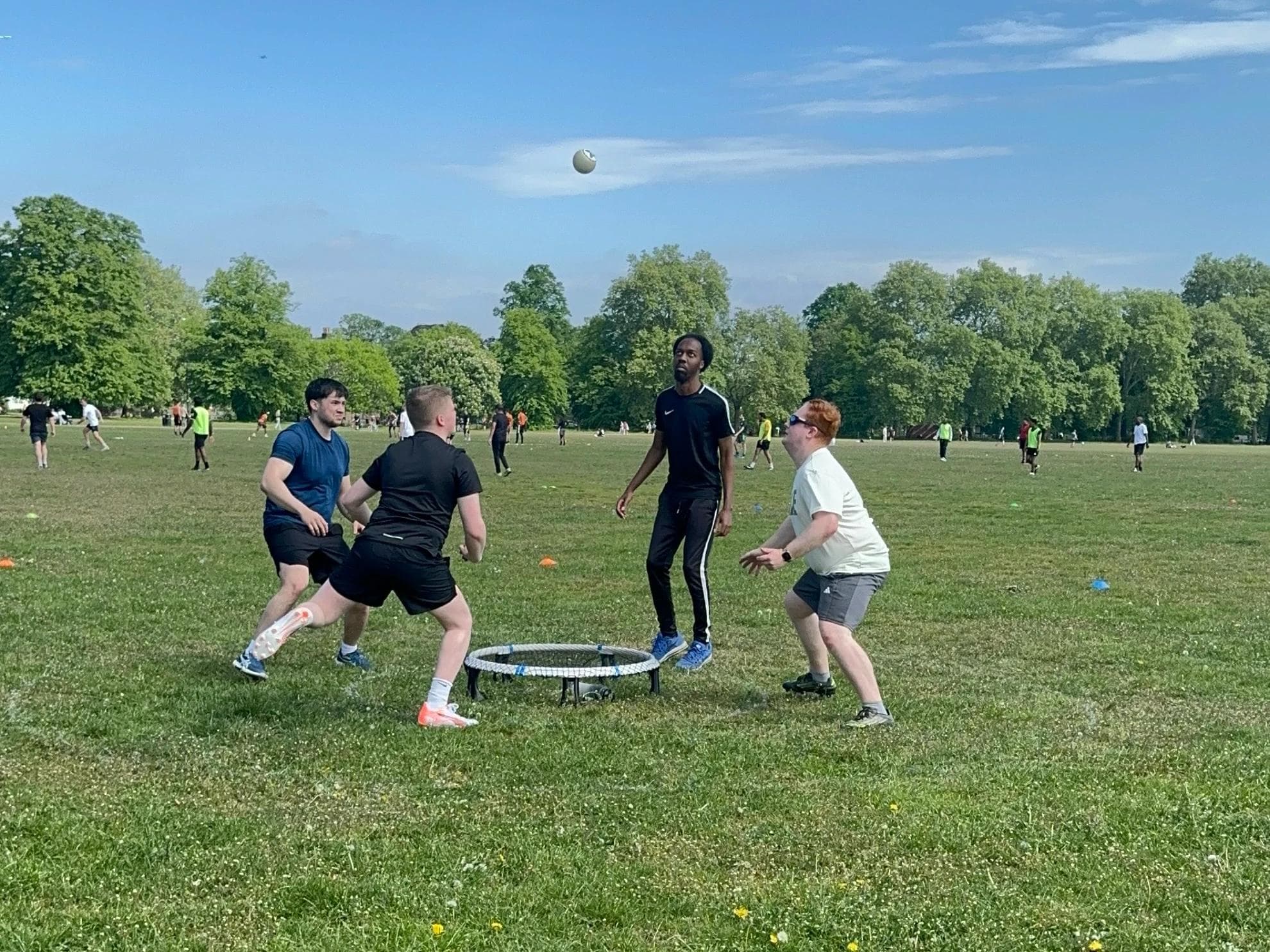
Quick answer: Sports development is the work of creating and improving opportunities for people to take part in sport, stay involved, and progress as far as they want to go. It covers everything from taster sessions and new clubs to coaching, volunteering, facilities and talent pathways, as well as using sport to improve health and communities.
That definition can feel a bit abstract, so here is a real version. Before April 2026, Leicestershire had no roundnet club. Today Hinckley Roundnet is a registered charity, affiliated to the sport's national governing body, running free taster sessions at local events and competing nationally. Every step of that journey was sports development.
This guide explains the definitions, the models, the organisations and the numbers behind sports development in the UK. Then it shows what all of that looks like when you try to grow a brand new sport in a market town.
What is sports development?
At its simplest, the Scottish Auto Cycle Union describes sports development as "the promotion of sporting opportunities throughout a community or region". That is a good starting point, but it leaves out how big the field really is.
Academics take a wider view. In their introduction to a special issue of Sport Management Review on sport development systems, policies and pathways, Shilbury, Sotiriadou and Green frame sport development as being about participation and promoting the opportunities and benefits of taking part, in settings that run all the way from children's free play to professional sport.
In practice, sports development sits alongside a few jobs that people often mix up:
- Coaching improves the skills and performance of a player or team.
- PE teaches physical skills and knowledge as part of the school curriculum.
- Sports development builds the system around both: the clubs, sessions, volunteers, venues, competitions, partnerships and pathways that let people start playing and keep playing.
A coach makes a player better. A sports development worker makes sure there is somewhere to play, someone to coach, a league to join and a reason for people who have never tried it to turn up in the first place.
Development of sport vs development through sport
The most useful idea in the whole subject is that sports development has two meanings. Barrie Houlihan and Anita White built their 2002 book around exactly this question, calling it The Politics of Sports Development: Development of Sport or Development Through Sport?.
- Development of sport means growing the sport itself: more players, more clubs, more coaches and officials, better competitions and higher standards.
- Development through sport means using sport as a tool to achieve something else, such as better health, social inclusion, education, community cohesion or confidence.
Real projects usually do both at once. A new club grows its sport, and at the same time gives people a reason to get outside, make friends and move more. Funders often care more about the second meaning, while governing bodies tend to focus on the first. Knowing which one you are pitching for makes a big difference when you write a funding bid.
What is sport for development?
"Sport for development" is the international version of development through sport. It uses sport to support goals like peace, gender equality and economic development. The United Nations proclaimed 6 April as the International Day of Sport for Development and Peace through resolution A/RES/67/296, saying sport is ideally positioned to contribute towards its objectives for development and peace.
This field also uses a deliberately broad definition of sport. As sportanddev sets out using the UN Inter Agency Task Force definition, sport covers all forms of physical activity that contribute to physical fitness, mental wellbeing and social interaction, including play, recreation, casual and competitive sport, and indigenous games. That is a useful reminder that sports development is not only about elite competition.
The 4 stages of the sports development continuum
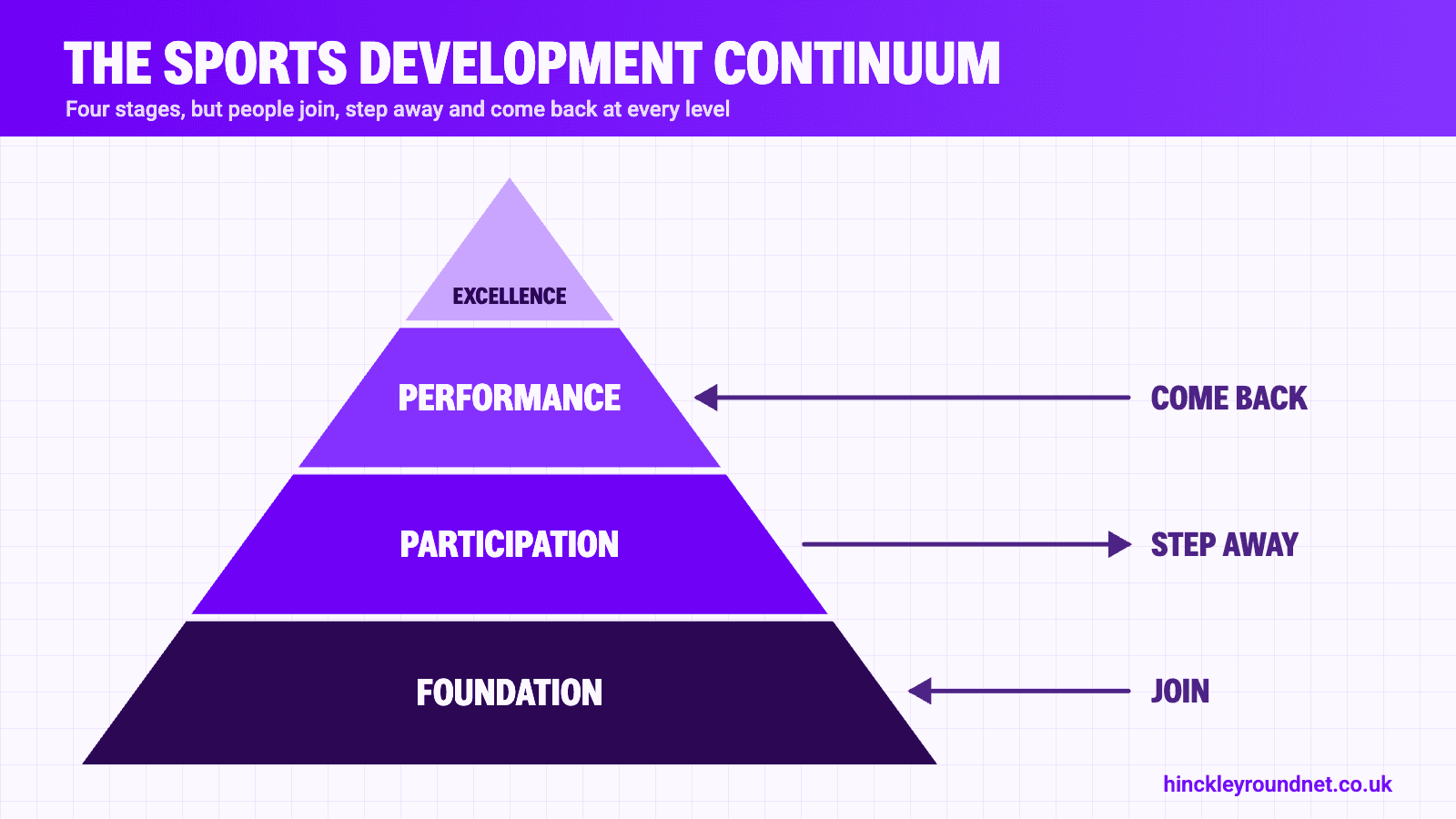
The sports development continuum has four stages, as set out in Sheffield Hallam University's introductory sport development lecture:
- Foundation: learning basic movement skills and a first understanding of a sport.
- Participation: taking part regularly for fun, fitness or friendship.
- Performance: training and competing to improve, often at club, county or regional level.
- Excellence: competing at national or international elite level.
Here is what each stage looks like in real life:
- Foundation: Learning to throw, catch, hit and move, plus the basic rules. Usually provided by schools, parents, community and holiday sessions. Roundnet example: a first go at a free taster session.
- Participation: Playing regularly for enjoyment, fitness or social reasons. Usually provided by clubs, leisure centres, informal groups, workplaces. Roundnet example: coming along to weekly club sessions.
- Performance: Structured training, coaching and competition. Usually provided by clubs, qualified coaches, county and regional squads, governing bodies. Roundnet example: entering national tournaments as a pair.
- Excellence: Elite, national and international competition. Usually provided by national governing bodies and high performance programmes. Roundnet example: representing your country at international level.
The pyramid model
The continuum is usually drawn as a pyramid. UK Coaching describes the base as "a large number of young beginners who are interested in learning the basics, having fun and developing fundamental movement skills", with the narrow top representing the few elite athletes who compete on the world stage. The logic is simple: the wider the base, the more talent there is to rise to the top.
Why the pyramid model is being challenged
The pyramid is a handy picture, but it has real weaknesses. UK Coaching lists challenges with the pyramid model including unequal resource allocation, barriers to access, inconsistent talent identification, limited entry and exit points, high dropout rates, bias and inequality, and pressure on young performers. It argues for a wider pathway with multiple entry and exit points that supports non linear journeys.
That matches what happens at grassroots level. People do not climb neatly from the bottom to the top. Someone might take up a new sport at 35. Someone else might stop at 16 and come back at 30, or step back from competition to play socially with friends. A good sports development plan treats every one of those journeys as a success, not only the ones that end at the top.
The aims of sports development, with examples
The core aim, as consultancy BCW Sports puts it, is to create and enhance sporting opportunities that lead to higher participation, particularly among young people and under represented groups. In practice that breaks down into a few clear aims:
- Increase participation, especially among people who are currently less active.
- Reduce inequality, so that age, income, gender or disability is less of a barrier to taking part.
- Improve health and wellbeing, both physical and mental.
- Build stronger communities by bringing people together around a shared activity.
- Create pathways so people who want to improve and compete have a route to do it.
- Grow the workforce of coaches, officials and volunteers that every sport depends on.
Examples of sports development
Sports development is easiest to understand through examples. All of these count:
- Starting a new club in a town that does not have one
- Running free taster sessions at a village festival or summer fair
- A walking football or walking netball group for older adults
- A school club linked to a local community club, so pupils have somewhere to keep playing
- A beginners' session aimed at women and girls who have never played before
- An inclusive session designed for disabled players
- Training volunteers to become coaches or referees
- Building or refurbishing a pitch, court or sports hall
- A county development squad for promising young players
Who delivers sports development in the UK?
No single organisation owns sports development. It works through a network of national, regional and local partners. Here is how that looks in England.
Sport England
Sport England invests government and National Lottery money into sport and physical activity, as its 2024/25 annual report and accounts set out. Its ten year strategy, Uniting the Movement, launched in January 2021 and is built around five big issues:
- Recover and Reinvent
- Connecting Communities
- Positive Experiences for Children and Young People
- Connecting with Health and Wellbeing
- Active Environments
National governing bodies
Every sport has a national governing body (NGB) that sets the rules, runs competitions, trains coaches and supports clubs. For our sport, British Roundnet describes itself as "the National Governing Body for the sport of Roundnet in Britain". Affiliating to your NGB is usually one of the first things a new club does, because it unlocks insurance, competitions and support.
Active Partnerships
Active Partnerships are locally led, not for profit organisations that between them cover the whole of England. They connect clubs, councils, schools, health services and funders in their area. Ours is Active Together, the Active Partnership for Leicestershire, Leicester and Rutland.
Local authorities, schools and colleges
Councils run leisure centres, parks and playing fields, and many have their own sports development or physical activity teams. Schools and colleges deliver PE and school sport, and are often the first place a young person tries a new activity.
Clubs, charities and volunteers
This is where the regular playing happens week to week. Many community clubs and charities are run entirely by volunteers, and there are a lot of volunteers out there: Sport England's Active Lives Adult Survey for November 2024/25 found that 10.9 million adults (22.7%) gave up their time to support sport and physical activity.
Why sports development matters: the numbers
The UK Chief Medical Officers' physical activity guidelines recommend that adults do at least 150 minutes of moderate intensity activity a week (or 75 minutes of vigorous activity), and that children and young people average at least 60 minutes a day. Plenty of people are not there yet.
Adults
According to the Active Lives Adult Survey November 2024/25, 64.6% of adults in England (30.9 million) are active, doing 150 minutes or more a week. But 24.7% (11.8 million) are inactive, doing less than 30 minutes a week.
The gaps between groups are where sports development has the most work to do:
- Disabled adults: 49.1% active, compared with 69.8% of adults without a disability
- Most deprived areas: 56.7% active, compared with 69.8% in the least deprived areas
- Women: 62.2% active, compared with 67.3% of men
- Aged 75 and over: 44.3% active, compared with 70.5% of adults aged 16 to 34
Source: Sport England Active Lives Adult Survey, November 2024/25
Children and young people
Sport England's Active Lives Children and Young People Survey for the 2024/25 academic year found that 49.1% of children and young people (3.6 million) average 60 minutes or more of activity a day, while 28.4% (2.1 million) average less than 30 minutes.
The value to society
Sport England's research on the social value and return on investment of sport and physical activity puts the annual social value of community sport and physical activity in England at £122.9 billion, a return of £4.38 for every £1 spent. That includes £8.0 billion in direct healthcare savings. The same research estimates the social cost of inequality in activity levels at £19.6 billion a year.
Put simply, every new person who finds a sport they enjoy is good for them, and good for everyone else too. That is the case sports development makes to funders, councils and the NHS.
Sports development on the ground: a new sport in Hinckley
This section is a first hand account from Hinckley Roundnet, to show how the theory above plays out in real life.
I founded Hinckley Roundnet in April 2026 as Leicestershire's first roundnet club. If you have not come across the sport yet, our beginner's guide to roundnet explains how it works. Growing a sport from nothing in a new area is about as pure a sports development project as you can get, because there is no existing base to build on. Here is how our first six months map onto the continuum.
Foundation: go where people already are
Nobody searches for a sport they have never heard of, so we took it to them. We ran free taster sessions at community events such as the Market Bosworth Festival and Ravenstone Picnic on the Green. Roundnet suits this well, because beginners pick up the basics in minutes and a set fits in a car boot.
Participation: give people somewhere to keep playing
A taster session only matters if there is a next step. Club sessions give new players a regular place to play, improve and meet people. Anyone who enjoyed a taster can register their interest and we let them know what is coming up.
Performance: create a route to compete
For players who catch the competitive bug, the club competes nationally. That gives the club something to aim for and shows newer players where the sport can take them.
The structures nobody sees
The least glamorous part of sports development is often the most important. In our first six months we:
- Affiliated with British Roundnet and put insurance in place
- Wrote a constitution based on the Charity Commission's model for a charitable incorporated organisation (CIO)
- Registered as a charity in September 2026 (registered charity number 1219788), with a board of trustees
- Opened a charity bank account
- Built support from local business sponsors
What we have learned so far
Five lessons for anyone thinking about starting a club or growing a sport in their area:
- Make trying it free and easy. The first session is the hardest one to get people to.
- Show up where the community already gathers. Festivals, fairs and parks beat flyers.
- Sort the boring stuff early. Affiliation, insurance and a proper constitution make everything else, including funding, possible.
- Partner locally. Local businesses, councils and your Active Partnership want community sport to succeed.
- Plan for people to dip in and out. Not everyone wants to compete, and that is fine. A social player who keeps coming back is a win.
Careers, qualifications and funding
What does a sports development officer do?
Sports development officers plan and run the programmes described above. According to the National Careers Service profile for sports development officers, the job includes planning and tailoring schemes for different groups, managing staff and volunteers, securing funding, managing budgets, carrying out risk assessments and writing reports. Typical salaries run from around £23,000 for new starters to £35,000 for experienced officers, on 37 to 40 hours a week, with some evenings and weekends.
What qualifications do you need?
The National Careers Service lists several routes in:
- A degree, foundation degree or higher national diploma in sports development, coaching, sports science or leisure studies
- College courses in community sports leadership, sports development or coaching
- An apprenticeship, such as the Level 2 Community Activator Coach or the Level 3 Community Sport and Health Officer
- Volunteering, for example helping with coaching or community sport schemes
Experienced officers can move into management, regional or national policy roles, or freelance consultancy. Whichever route you take, helping to run real sessions at a local club is one of the best ways to find out whether the work suits you.
How is sports development funded?
Funding comes from a mix of public money, the National Lottery, local councils, charitable trusts, sponsorship and membership fees. For small community groups in England, a common starting point is Sport England's Movement Fund, which offers grants or crowdfunding pledges from £300 to £15,000 for projects that help people who face barriers to being active. With the crowdfunding route, Sport England contributes half the cost if you raise the other half from your community.
How to get involved in sports development
You do not need a job title to do sports development. If you volunteer at a club, help run a session, take a coaching course or start something new in your area, you are part of it. Your local Active Partnership is a great first contact, and your sport's national governing body can help with the practical side of starting a club.
And if you are in or around Hinckley and want to see what grassroots sports development looks like up close, come and give roundnet a go. Register your interest or check our upcoming events for the next free taster session.
Frequently asked questions
What are the 4 stages of the sports development continuum?
The four stages are foundation, participation, performance and excellence. Foundation is learning basic skills in the sport, participation is playing regularly for enjoyment or socially, performance is training and competing to improve, and excellence is elite national or international competition.
What are the aims of sports development?
The main aims of sports development are to increase participation, reduce inequality in who gets to play, improve health and wellbeing, build stronger communities, create pathways for people who want to compete, and grow the workforce of coaches, officials and volunteers.
What are examples of sports development?
Examples include starting a new club, running free taster sessions at a local festival, setting up walking football for older adults, linking a school club to a community club, training volunteers as coaches, running inclusive sessions for disabled players and improving local facilities. Our Hinckley case study above shows several of these in action.
Why is sports development important?
Nearly a quarter of adults in England are inactive, and activity levels are much lower among disabled people, older adults and people in deprived areas. Sports development tackles those gaps. Sport England values community sport and physical activity at £122.9 billion a year in social value.
What is the difference between sport development and sport for development?
Sport development usually means growing a sport itself: more players, clubs, coaches and better competitions. Sport for development uses sport as a tool to achieve wider goals such as health, education, social inclusion or peace. Many projects do both at the same time.
What qualifications do I need for sports development?
There is no single required qualification. Common routes include a degree or HND in sports development, coaching or sports science, college courses, the Level 2 Community Activator Coach or Level 3 Community Sport and Health Officer apprenticeships, and volunteering experience.
Keep Reading
Related posts from the blog.
 Guides
What Is Roundnet? A Complete Beginner’s Guide
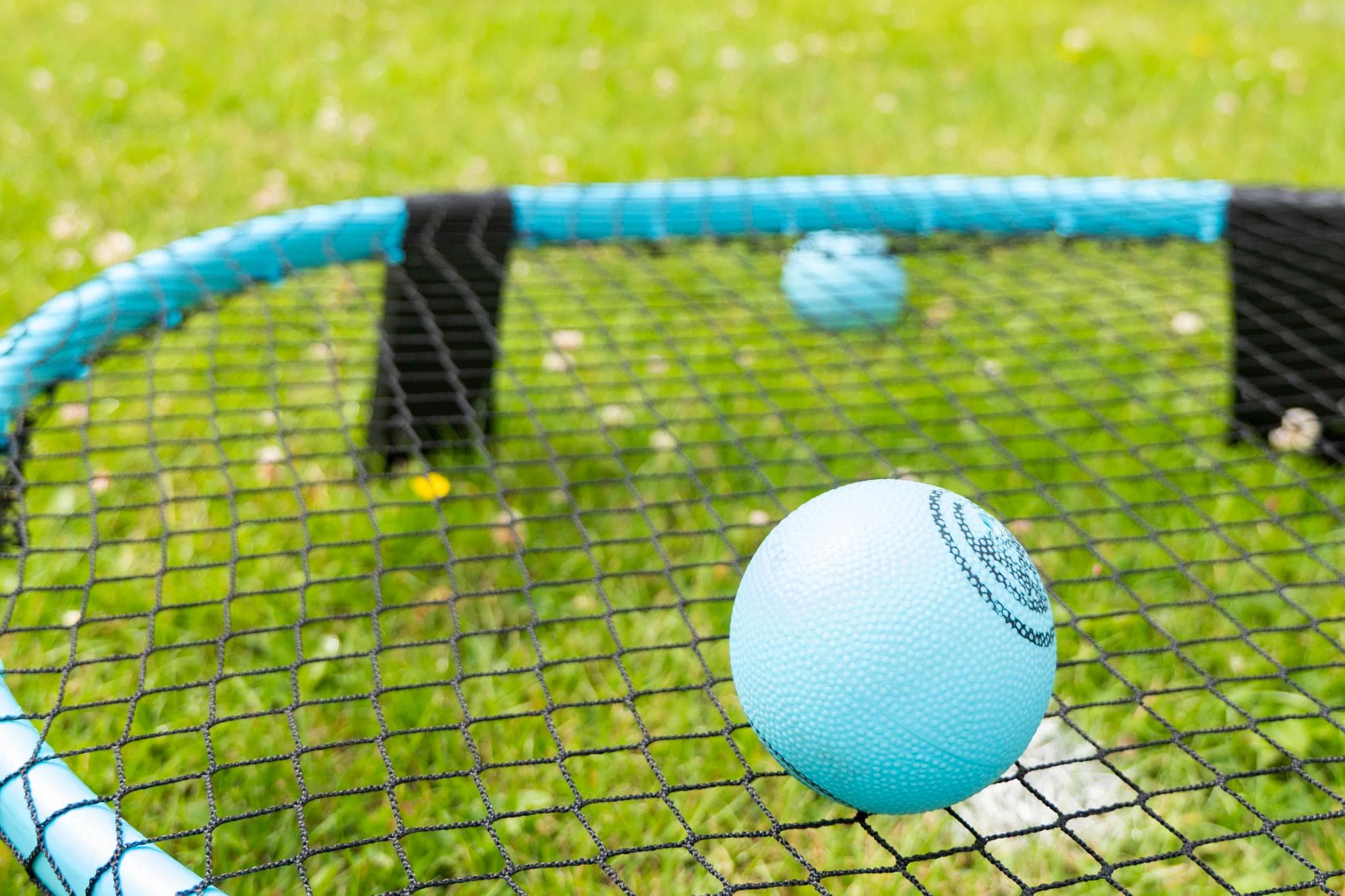
Roundnet, often known as Spikeball, is a fast, social sport played around a small circular net. Learn the basics, key rules, court markings and how to get involved with Hinckley Roundnet.
Read Story